Publication
Practical Obfuscation of BLE Physical-Layer Fingerprints on Mobile Devices
Overview
Abstract and highlights
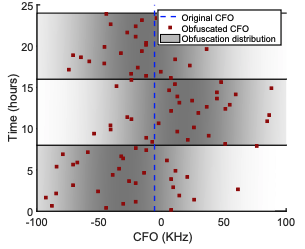
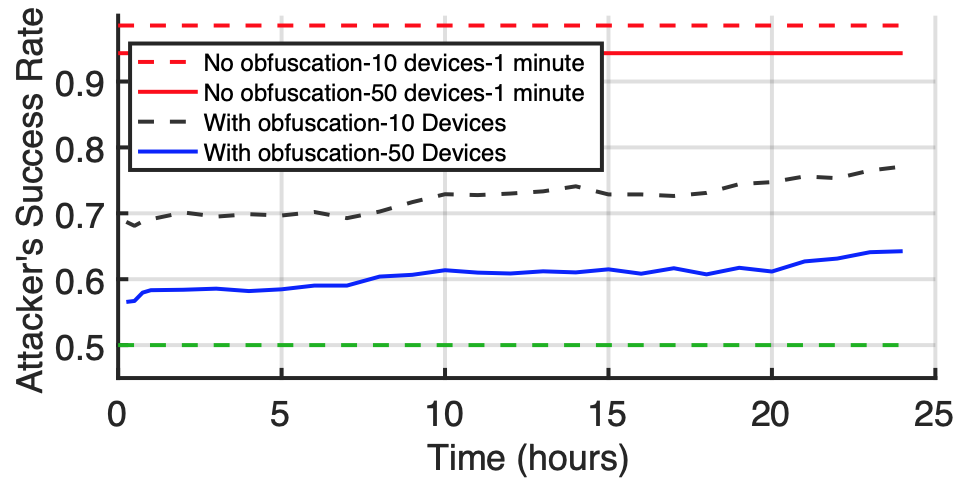
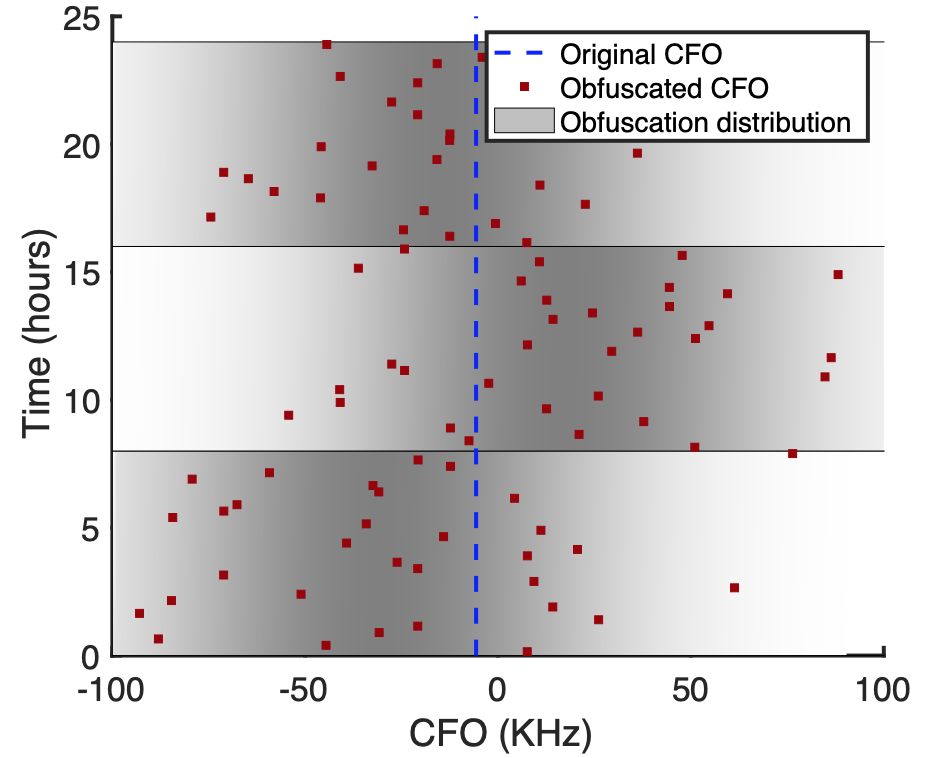
Mobile devices continuously beacon Bluetooth Low Energy (BLE) advertisement packets. This has created the threat of attackers identifying and tracking a device by sniffing its BLE signals. To mitigate this threat, MAC address randomization has been deployed at the link-layer in most BLE transmitters. However, attackers can bypass MAC address randomization using lower-level physical-layer fingerprints resulting from manufacturing imperfections of radios. In this work, we demonstrate a practical and effective method of obfuscating physical-layer hardware imperfection fingerprints. Through theoretical analysis, simulations, and field evaluations, we design and evaluate our approach to hardware imperfection obfuscation. By analyzing data from thousands of BLE devices, we demonstrate obfuscation significantly reduces the accuracy of identifying a target device. This makes an attack impractical, even if a target is continuously observed for 24 hours.
Furthermore, we demonstrate the practicality of this defense by implementing it by only making firmware changes to commodity BLE chipsets.
Citation
Reference
Hadi Givehchian, Nishant Bhaskar, Alexander Redding, Han Zhao, Aaron Schulman, Dinesh Bharadia